Article
How Brent Yeager Built a Bigger, More Profitable Bin Store by Thinking Like a Liquidator
Brent Yeager breaks down the $125,000 move, the layered pricing model, and why volume beats holding out for margin.
 Zac Montgomery

How Brent Yeager Built a Bigger, More Profitable Bin Store by Thinking Like a Liquidator
Brent Yeager breaks down the $125,000 move, the layered pricing model, and why volume beats holding out for margin.
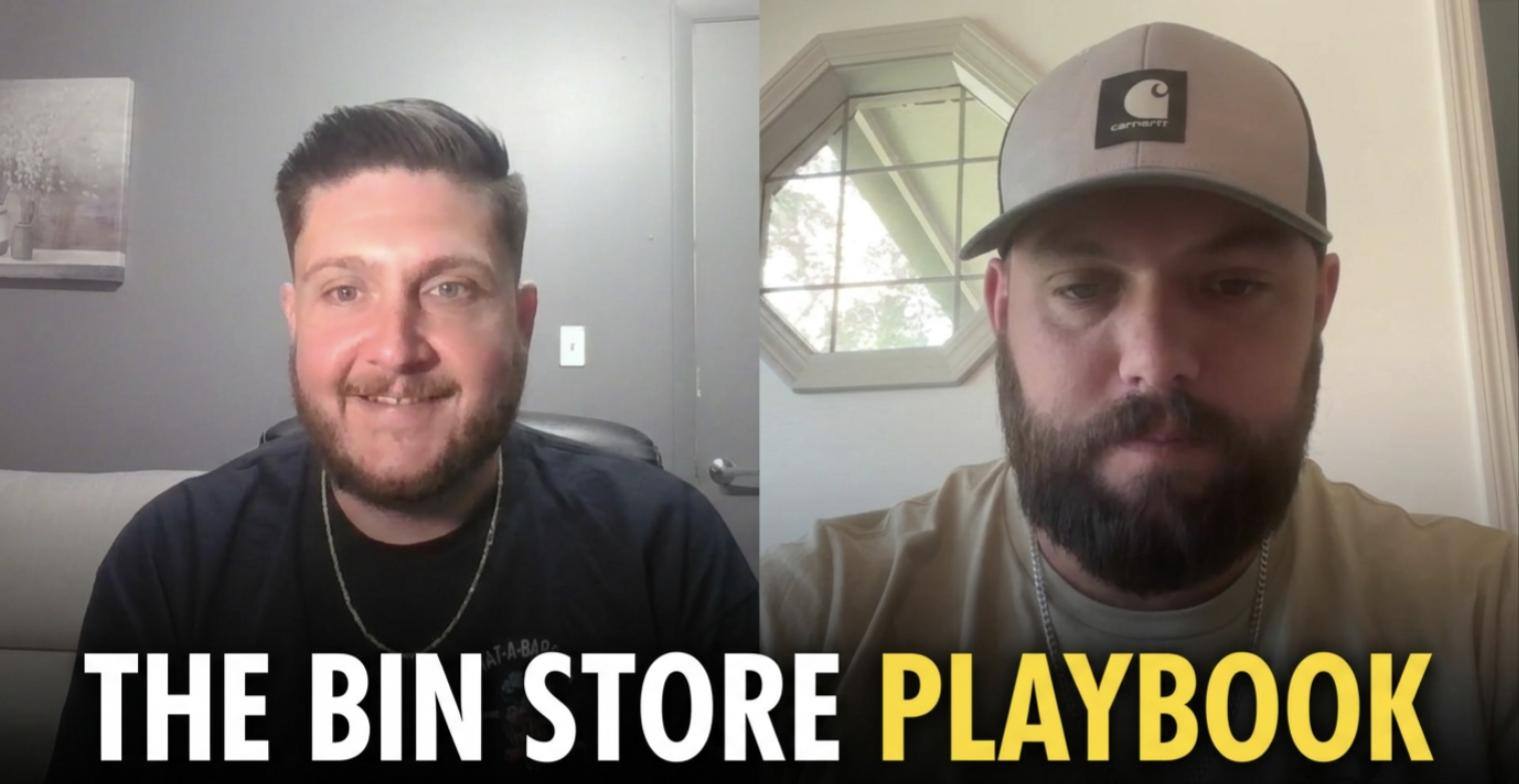
If you think bin stores only work when product is cheap and traffic is easy, Brent Yeager has a different lesson for you. In this conversation, he breaks down how he moved from two separate locations into one larger store, why his pricing model still works in a tougher market, and what most operators miss when they try to scale too fast.
Brent's approach is part retail, part liquidation, and part logistics. He is not just filling bins and hoping for the best. He is layering product strategically, managing relationships with suppliers, and using marketing to keep customers coming back.
Why Brent Moved Into a Bigger Space
Brent's old store had one problem most owners would love to have. It was too busy.
He said the location had been open for five years, but the volume eventually became a liability. On restock days, hundreds of people would line up outside, the store would hit occupancy limits almost immediately, and local officials started stepping in. Fire marshals, the town, the mayor, and even neighbors all had complaints. At that point, staying put stopped being an option.
The move solved more than just crowd control. Brent shifted into a location with roughly double the square footage and three times the parking. That alone changed the customer experience and gave the business room to breathe. Sales also improved. He said the new location nearly doubled what the old one was doing.
The interesting part is that the move was not just about size, it was about fit. Brent relocated from a smaller city setting into a plaza area with national chains nearby, including Target, Kohl's, and Ashley Furniture. That came with higher rent and more requirements, but it also put the store in a more visible, higher-traffic retail environment.
The hidden reason the move made financial sense
Brent also had to combine his discount grocery section with the bin store. Why? Because the new rent was too high to justify two separate spaces.
That is one of the biggest takeaways from his move: growth can force consolidation. The grocery section still works, but now it lives inside the larger bin store footprint. Instead of paying two leases, two sets of overhead, and two locations to manage, he simplified the operation and kept the strongest parts of both businesses under one roof.
For a lot of operators, that is the real lesson. Growth is not always about adding more doors. Sometimes it is about making one better building do the work of two smaller ones.
The Real Cost of Opening a Bigger Bin Store
A lot of people think moving up to a nicer retail location is mostly a rent decision. Brent's story shows it is much more expensive than that.
He spent months negotiating the building and then several more months getting open. Because the plaza was home to national brands, the lease process was more formal and involved lawyers. The deposit structure was also much tougher than what many small landlords require. Instead of first and last month's rent, he had to put up three months of rent plus an escrowed security deposit held for five years.
Then came the build-out.
Brent said he had to replace signage that was not approved, which cost him around $10,000. He also built all-new bins, which ran roughly $13,000 to $14,000. He added shelving, paid movers, did electrical work, and covered labor while the store was still closed. Because he was opening a much larger store, inventory and staffing had to scale too.
By the time he got in the door and opened, he estimated he had spent about $125,000 to $130,000, before even buying product.
That number matters because it changes how you think about the business. A bin store can look like a low-cost startup from the outside, but once you move into a serious location, the costs stack up fast. Build-out, labor, rent, signage, and timing all matter. If you are opening on a shoestring budget, this is the part of the model that can break you.
Why timing matters more than people think
Brent also talked about the pressure of opening while still paying employees and carrying overhead. Even with a two-month rent concession, the way the lease was written meant the clock did not really help as much as it first seemed. He was still paying staff during the move and had to keep them around so he would not lose the team he had built.
That is another hidden cost many owners underestimate: payroll does not pause just because your doors are closed.
If you shut one business to open another, the money still has to come from somewhere. Brent's move worked because he had the cash flow and the volume to support it. Without that cushion, a move like this could become a cash crunch very quickly.
Brent's Pricing Model: Volume, Not Emotion
This is where Brent's operation really stands out. He does not treat every item like a treasure. He treats the store like a system.
Brent said he buys one Amazon FC load every week, but he is not loyal to Amazon as a category. He mixes in Walmart high-piece-count loads, Walmart GM, Target GM, and shelving inventory. His bins are layered strategically, and his shelf inventory is treated as part of the same pricing ladder.
At the top, many items start at $12. Then they fall to $10, $7, $5, $3, and $1 across the week. Clothing follows its own ladder at $6, $5, $4, $3, $2, $1. Grocery is also priced on a bin-style model, which keeps the whole store aligned around velocity and turnover.
His reasoning is simple. If he pays about $4.25 landed for an item and sells it for $12, he can make the spread work without needing to maximize every single item individually. He is not trying to squeeze every ounce out of one iPad or TV. He is trying to make money across the whole week.
That is a major mindset shift. A lot of bin store owners get emotionally attached to product and want to hold out for the highest possible price. Brent does the opposite. He moves product fast, keeps cash flowing, and trusts the math.
Why this model works for him
Brent said that by day one, he usually covers 75% to 100% of his product cost. By day two, the product cost is often fully covered. Monday and Tuesday usually pay the overhead and payroll. Wednesday and Thursday are the profit days. Saturday and Sunday help cover the initial product expense.
That is why he can afford to keep the store open so much. The price drops are not just a markdown schedule, they are part of the engine.
He also uses high-interest, high-traffic items like TVs, cell phones, and iPads as traffic drivers. Even if only a few of those sell, they pull people into the store, and those people still buy other items.
Brent's model is not about winning every sale. It is about making the whole system work.
Why Marketing and Relationships Matter More Than Product
If there is one theme Brent kept coming back to, it is this: product alone does not build a business. Marketing does.
He said he does not rely on paid ads. Instead, he uses Facebook, TikTok, Instagram, billboards, and repeat content. He even put billboards near the people who complained about his old store. Now, when people enter the area, they see his face and his new location. It is loud, direct, and impossible to miss.
He also believes consistency is essential. If you say you are open from 11 to 6, then be open from 11 to 6. If you say a restock day is Friday, make Friday happen. Customers notice when businesses are reliable, and in a crowded market, reliability builds trust.
But Brent went even further than that. He said the best suppliers are the ones you already have relationships with. He plans inventory a week ahead, keeps backup loads on deck, and works with vendors who trust him enough to prioritize his orders. In his view, bin store success is not just about moving volume, it is about building enough trust to make the volume possible.
That matters because a lot of operators are now trying to buy inventory at the last minute. Brent sees that as a warning sign. If you have to wait until Wednesday or Thursday to pay for the load you need by Friday, you are probably too exposed.
The customer experience is part of the marketing
Brent and Zac both landed on the same point from different angles. Customers are more likely to come back when the experience feels clean, organized, and fair.
That means signage matters, the store layout matters, staff attitude matters, and even the way pricing is announced matters. Brent uses a megaphone on busy days to explain the rules and set expectations. He also uses testing stations so people can check items before they buy, though he still deals with customers opening boxes when they should not.
The takeaway is simple. In a business where you cannot control the product mix every week, you can still control how the store feels. That is often the difference between a one-time shopper and a regular.
The Hard Truth About Bin Stores Today
Brent did not sugarcoat the market. Neither did Zac.
Their shared view is that bin stores are not the easy business they once were. Product costs are higher, quality can be lower, and customers are more price-sensitive than they used to be. Some stores are struggling because they never really learned how to run a business. Others are failing because they waited too long to get serious about suppliers, marketing, and cash flow.
Brent's advice to new owners was blunt: do not open unless you have enough capital to survive losses. He recommends having at least a month of cushion, and probably more. He also thinks the business is becoming more competitive and less forgiving.
That does not mean bin stores are dead. It means the old model, dump cheap product into bins and hope for the best, is getting harder to sustain.
The stores that survive are the ones that:
- plan inventory ahead
- build real supplier relationships
- market aggressively
- keep operating consistently
- understand volume economics
- respect the fact that customers want deals, not chaos
Brent also made a point that matters for almost every retailer: do not hate your resellers. They are often your most consistent buyers, and they help keep cash moving even when everyday traffic slows down. Some may be difficult, but they are still part of the ecosystem. If you get to know them, they may even turn into business opportunities beyond the bin store.
Key Takeaways for Bin Store Owners
- Bigger spaces can solve traffic problems, but they also increase rent, compliance, and build-out costs.
- A successful bin store is usually a volume business, not a single-item-margin business.
- Marketing is not optional. It is how people find you, remember you, and return.
- Supplier relationships matter as much as customer traffic.
- Resellers are not the enemy. They are often your most reliable customers.
- If you want to open a bin store today, you need capital, discipline, and a plan.
Frequently Asked Questions
How much does it cost to open a larger bin store?
It depends on the building, but Brent estimated his move and build-out cost around $125,000 to $130,000 before product. That included rent deposits, signage, bins, labor, and electrical work.
Why do some bin stores open fewer days per week?
Some stores close extra days to save labor and process inventory. Brent stays open more often because his sales volume makes the extra day profitable.
How does Brent price items in his store?
He starts many items at $12, then drops to $10, $7, $5, $3, and $1. Clothing and grocery follow their own low-price ladders.
Do bin stores still work in 2026?
Brent thinks they can, but only if you have capital, supplier relationships, and a real business plan. He does not recommend opening one without preparation.
Why are supplier relationships so important in liquidation?
Because inventory timing can make or break your week. Strong relationships help you get better loads, better pricing, and more consistency.
No comments yet. Be the first to share your thoughts!